
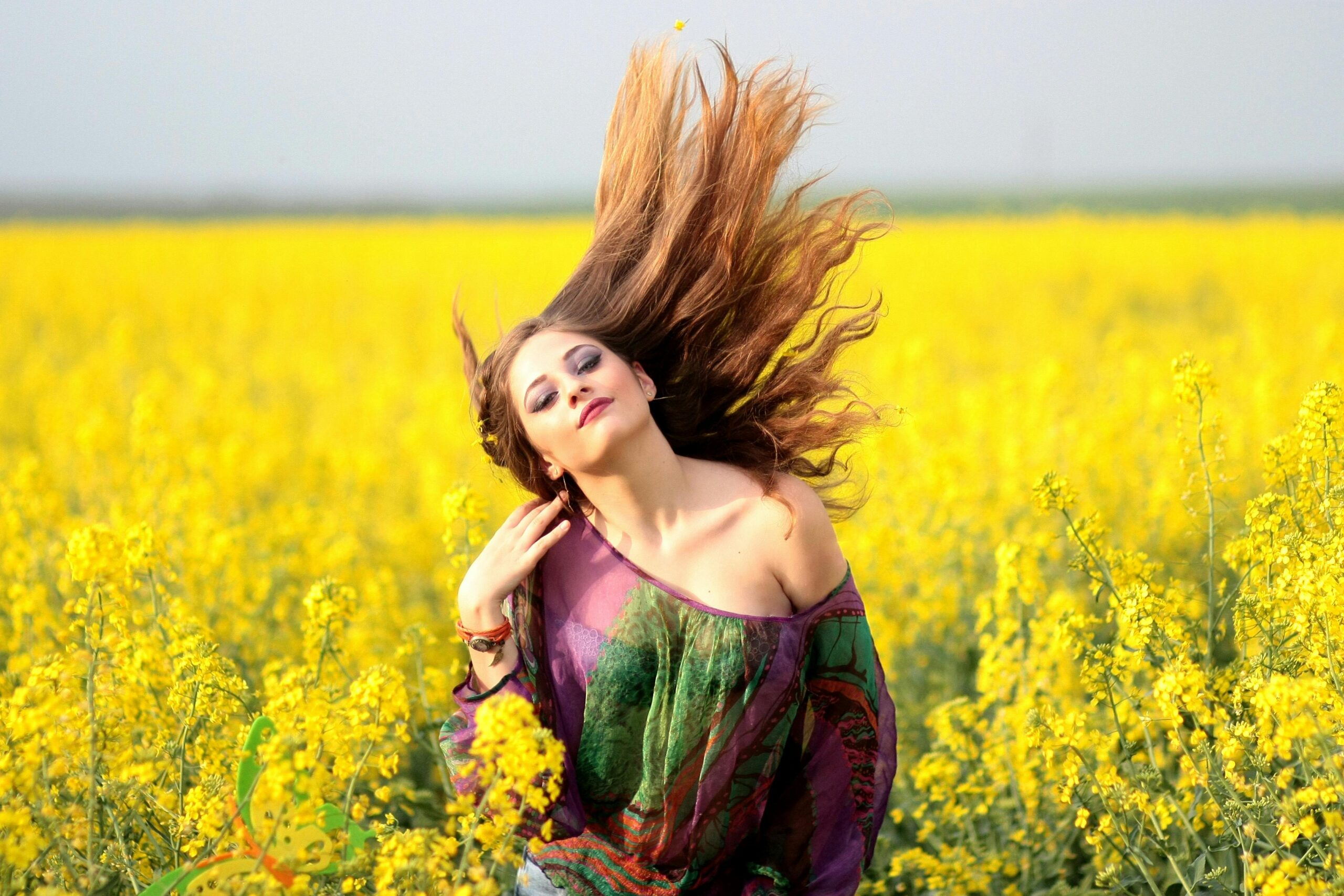
Frizzy hair in spring? Here’s why it happens and how to manage humidity without stress
In spring, hair changes its behavior even before we notice it.
The style seems to hold, then — within a few hours — it loses definition. The volume expands, the surface rises, and the feeling is that of a balance breaking without an obvious cause.
In reality, the cause is very simple: the air.
As humidity increases, the capillary fiber interacts with the environment differently. And that is exactly where the styling begins to give way.
It’s not frizz. It’s a fiber reaction
Hair is not a waterproof structure. It absorbs.
When humidity increases, the fiber incorporates water from the outside and temporarily modifies its shape. It is a natural process, but visible:
- definition fades
- the surface loses compactness
- volume becomes less predictable
- shine is reduced
Wavy and curly hair manifest this more quickly, but in spring, even straight hair loses its precision.
It is not about countering the phenomenon, but managing it.
More heat is not the solution
When the style doesn’t hold, there is a tendency to increase the temperature. It is an instinctive reaction, but not very effective.
Excessive heat opens the cuticle, making the hair even more exposed to humidity. The result is a cumulative effect: greater vulnerability, shorter styling duration.
In this season, the difference is not made by the amount of heat, but by the quality of the work.
Drying: a matter of control
A powerful and well-directed airflow allows for reducing times and improving the uniformity of drying.
The most recent technologies work precisely on this aspect. In the iQ Line, for example, the brushless motor is combined with the Venturi effect, which accelerates and concentrates the airflow. This allows for obtaining faster results without increasing the temperature, limiting stress on the fiber.
Also the final cold air shot plays a fundamental role: it stabilizes the shape and contributes to closing the cuticle, improving hold in humid conditions.
Technology and hair structure
Today the difference is played on the capacity to intervene on the hair structure during styling.
The LUMINE 80 Digital integrates Plasma Technology, a combination of positive and negative ions that acts on the electrostatic balance of the fiber. The result is a more compact surface, less inclined to lose shape and more resistant to humidity.
A more orderly fiber absorbs less water. And it maintains the obtained result for longer.
The straightener, with measure
The straightener remains a useful tool, but it requires precision.
Accurate temperature control — as in the case of the Bravo LED — allows for adapting the heat to the hair type, avoiding unnecessary stress. Uniform heating allows for working with fewer passes, reducing mechanical stress.
Technologies like Oxy Active also contribute to improving brightness and protection, making the styling more stable over time.
A matter of balance
Humidity is not an element to be eliminated, but a variable to be considered.
Reducing heat exposure times, working on the quality of the fiber and choosing adequate tools allows for obtaining a more stable result, even during seasonal changes.
Because in spring it’s not about controlling the hair.
But about putting it in the condition to remain so.